
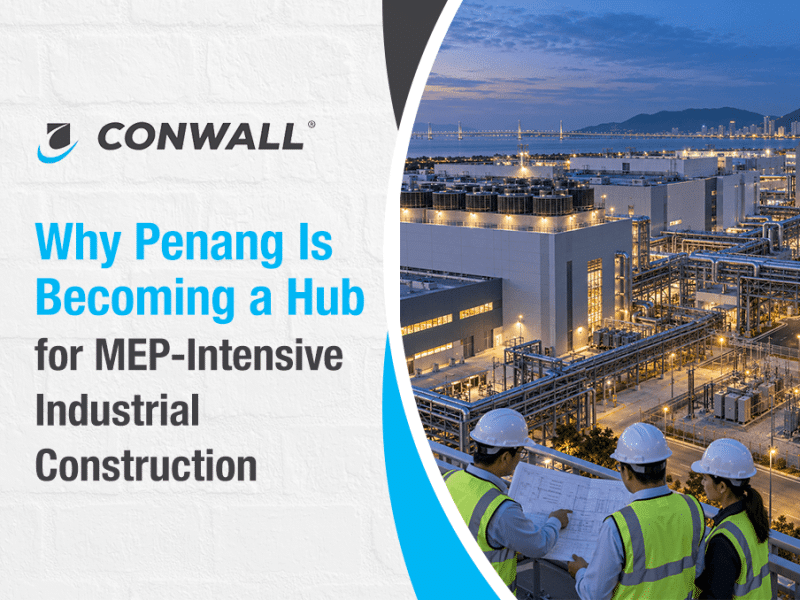
If you’d told someone in the 1970s that a small island off Malaysia’s northwest coast would end up handling a meaningful share of the world’s chips, they’d have had questions. Penang was a port town then, known more for trade than technology. Today it’s commonly nicknamed the Silicon Valley of the East, and the numbers behind that nickname have been getting harder to ignore — particularly for anyone in construction.
Penang secured RM4.9 billion in approved manufacturing investments in the first quarter of 2026 alone, ranking second nationwide, with foreign direct investment making up around 70% of that total. Electrical and electronics, alongside machinery and equipment, accounted for roughly three-quarters of it. That’s not a one-off spike — it’s the continuation of a decades-long build-up that’s now translating directly into demand for one very specific type of construction expertise: MEP-intensive industrial building.
Here’s why that concentration is happening in Penang specifically, and what it means if you’re planning to build there.
A Manufacturing Base That’s Been Compounding for 50 Years
Penang’s semiconductor story didn’t start recently. It began in the 1970s when Malaysia’s first free trade zone drew in the initial wave of multinational manufacturers, and the state has been layering capability on top of that foundation ever since. By 2019, Penang was already responsible for an estimated 5% of global semiconductor exports — a remarkable figure for a state with just over 1,000 square kilometres of land.
That head start matters more than it might seem. Fifty years of continuous investment means Penang isn’t building an industrial ecosystem from scratch — it has an existing base of skilled technicians, established supply chains, and contractors who’ve already worked on facility types that most regions have never had to build. When a global chipmaker is deciding where to locate a new fab, that depth of existing capability is a real factor, not just a nice-to-have.
The Numbers Behind the Current Boom
The scale of what’s happening in Penang right now is hard to overstate. In the first half of 2026, the state recorded more than RM350 billion in electrical and electronics exports — up over 80% year-on-year — and Penang consistently accounts for more than 60% of Malaysia’s total E&E exports. On the trade side, Penang remained Malaysia’s top exporting state in 2025, contributing 38.1% of the country’s total exports.
That growth isn’t confined to existing players expanding. Recent investment activity spans the full spectrum of the semiconductor value chain:
- Taiwan’s Chipbond Technology opened an advanced packaging and testing facility in Penang after investing close to $200 million, with capacity for 10,000 wafers and 100 million wafer-level chip-scale packaging units a month
- Germany’s Aixtron committed roughly €40 million to build a facility supporting deposition equipment assembly and testing
- The state government allocated land for a new Automation, Test and Equipment campus aimed at deepening the local ATE supply chain, bringing together multinational and local equipment companies
Each of these is, underneath the investment headline, an MEP-intensive construction project — cleanrooms, redundant power, process utilities, and specialised cooling, all needing to be built and commissioned on a schedule tied to a global product roadmap.
Why This Specifically Drives MEP Demand, Not Just Construction Generally
It’s worth being precise about why Penang’s boom translates into MEP demand specifically, rather than just “more construction.” Semiconductor and advanced electronics facilities are unusually MEP-heavy compared to almost any other building type — cleanroom air handling, high-density power distribution, process gas and ultra-pure water systems, and redundant cooling architecture all sit inside MEP scope, and on facilities like these, MEP frequently represents the largest single cost category on the project.
Penang’s investment mix leans hard into exactly the sectors that require this. Electrical and electronics, plus machinery and equipment, made up roughly three-quarters of approved manufacturing investment in the state in early 2026. That’s not general industrial building — it’s the specific category of facility where MEP complexity is highest.
The state is also actively moving up the value chain rather than just adding manufacturing volume, through initiatives like the Penang Silicon Design 5km+ cluster around Bayan Lepas, aimed at co-locating IC design, R&D, and supporting infrastructure. Higher-value activity tends to come with higher-spec facility requirements — tighter environmental control, more redundancy, more sophisticated MEP design — which reinforces the same trend from a different angle.
The Talent and Supply Chain Advantage
Concentration creates its own momentum. Because Penang has been building semiconductor and electronics facilities continuously for decades, it has something a newer industrial region simply can’t replicate quickly: a deep bench of contractors, engineers, and skilled trades who already understand cleanroom-grade MEP work, rather than encountering it for the first time.
That matters more than it might sound. The global semiconductor construction boom has made experienced MEP talent — cleanroom HVAC specialists, high-purity piping welders, commissioning engineers — one of the tightest constraints on project delivery worldwide. A region with an established base of this expertise has a genuine competitive advantage over one that would need to import that capability project by project.
Penang’s state government has recognised this as a strategic asset worth protecting, running public-private talent development partnerships specifically aimed at keeping the skilled workforce pipeline aligned with where the industry is heading — including newer, AI-driven and design-focused roles, not just traditional manufacturing and construction trades.

What This Means for Project Owners Planning to Build in Penang
For a company evaluating where to locate a new facility, or a project owner already committed to building in Penang, the practical implication is straightforward: you’re building in a market where MEP-intensive construction is not a niche capability; it’s the mainstream of what local contractors do. That has real upside — shorter supply chains for speciality MEP materials, a labour market that’s more likely to have direct cleanroom and process-utility experience, and contractors familiar with the coordination challenges specific to fab-grade builds, including how MEP work needs to sequence with equipment hook-up once process tools arrive on site.
It also means demand for that same specialist capacity is high, which is exactly why choosing an MEP contractor with genuine, current experience in Penang’s industrial construction market — not just general commercial MEP experience — matters more here than it might in a less specialised region.
Frequently Asked Questions
Why is Penang called the Silicon Valley of the East?
The nickname reflects Penang’s decades-long concentration of semiconductor and electronics manufacturing, dating back to the 1970s, which has made the state responsible for a significant share of global semiconductor exports relative to its small size.
What sectors are driving Penang’s current construction demand?
Electrical and electronics, along with machinery and equipment, are the leading sectors, accounting for roughly three-quarters of approved manufacturing investment in the state in early 2026 — both sectors that require MEP-intensive facilities like cleanrooms and high-density power infrastructure.
Is Penang’s semiconductor growth concentrated in manufacturing, or expanding into other areas?
Both. Alongside continued manufacturing investment, Penang is actively developing higher-value activity like IC design and R&D through initiatives such as the Silicon Design 5km+ cluster, which tends to require even more sophisticated facility infrastructure.
Does building in Penang make it easier to find experienced MEP contractors?
Generally, yes — the state’s long industrial history means there’s a deeper existing base of contractors and skilled trades with direct cleanroom and process-utility experience compared to newer or less specialized industrial regions.
The Bottom Line
Penang’s rise as a hub for MEP-intensive industrial construction isn’t a recent trend — it’s the compounding result of fifty years of manufacturing investment now accelerating alongside a broader regional semiconductor boom. For anyone planning a facility there, that concentration is a genuine advantage, provided the contractor you choose actually has the depth of MEP and equipment hook-up experience the local market has built its reputation on.
Based in the heart of this ecosystem, Conwall has spent years delivering MEP-intensive industrial and semiconductor facilities as an integrated EPC contractor, working alongside the same manufacturers and investors driving Penang’s growth. If you’re planning a facility here, our guide on MEP Contractors in Malaysia: A Complete Guide for Industrial & Semiconductor Projects breaks down what to look for in a contractor, or you can speak directly with Conwall’s team about what your project needs.
 English
  Chinese