
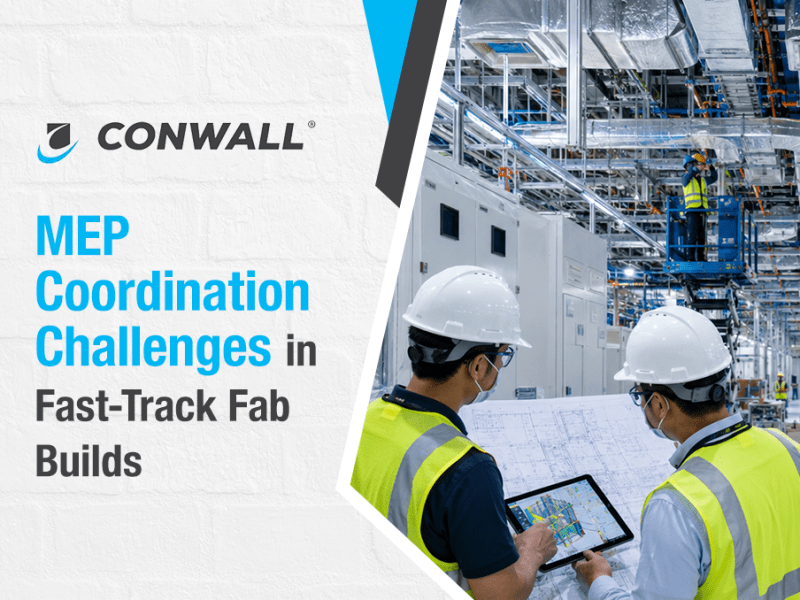
Ask anyone who’s actually run a fast-track fab project what keeps them up at night, and it’s rarely the concrete pour or the steel schedule. It’s the ceiling void where ductwork, cable tray, process piping, and cleanroom air handling are all fighting for the same six inches of space — on a schedule that doesn’t have room for a redo.
Fast-tracking a fab means compressing phases that would normally run in sequence — design, procurement, construction, commissioning — into overlapping windows. It works. Plenty of the world’s fastest fab ramps have been built this way. But it also removes the buffer that used to absorb MEP coordination mistakes, which is exactly why MEP has become the phase where fast-track schedules most often quietly fall apart.
Here’s what’s actually driving that, and what experienced EPC teams do differently.
Why MEP Is the Pressure Point, Not Just a Line Item
On a standard commercial building, MEP is significant but manageable. On a fab, it’s a different order of magnitude. Mechanical, electrical, and plumbing systems now commonly account for somewhere between 35% and 55% of total project cost on large-scale fabs and data centres — and that share has been climbing as facilities get denser, more power-hungry, and more dependent on precise environmental control.
Density is really the root of the problem. A modern fab crams more piping, ductwork, and cabling into its ceiling and sub-fab space than almost any other building type — by some comparisons, denser than a hospital, which has historically been considered one of the most MEP-intensive building types there is. When you then compress the schedule that installs all of that, you’re asking multiple trades to occupy the same physical space at nearly the same time, which is precisely the condition that produces clashes.
The Four Coordination Failures That Show Up Most Often
1. Trades working from outdated or uncoordinated drawings
This is the classic failure mode: ductwork gets hung, then the electrical crew shows up to route cable tray through the same space, and nobody caught the conflict beforehand because the two trades were working from drawings that hadn’t been overlaid. On a normal schedule, this gets caught in an RFI cycle. On a fast-track schedule, there often isn’t time for that cycle to run before the next trade is already on site.
2. Staffing sequencing gaps
Fast-track fabs need the right specialists in the right order — project executive, MEP manager, process utility lead, and eventually the OEM coordinator responsible for the equipment hook-up. Bringing any of these roles in late doesn’t just delay their own scope; the effect compounds downstream. A late MEP manager hire can turn into late utility terminations, which turns into idle process tools sitting on site waiting to be connected, which turns into a delayed wafer start date. It’s a chain, and fast-track schedules have very little slack to absorb a broken link.
3. Code and standards drift mid-project
Fast-track projects sometimes start construction before every design detail — or every applicable code cycle — is finalized. If a facility begins under one code cycle and the owner later needs to comply with an updated one (a common scenario with evolving energy and safety codes), MEP systems designed too rigidly around the original spec can require expensive rework. Teams that anticipate likely code shifts and build in some flexibility — extra conduit runs, oversized risers — avoid a lot of this pain later.
4. Disconnected MEP-to-equipment-hookup handoff
This is the failure that’s most specific to fabs, and it’s the one general construction experience doesn’t prepare a team for. MEP systems don’t exist for their own sake in a fab — they exist to feed process tools. If the MEP contractor terminates power, gas, and cooling utilities without tight coordination with the equipment hook-up team, tools can arrive on site to find the utility drops are in the wrong location, undersized, or simply not commissioned yet. That gap between “MEP complete” and “tool ready to run” is one of the most common — and most avoidable — sources of delay in fab ramp-up.
For a broader look at how MEP scope works across industrial projects, read our guide, MEP Contractors in Malaysia: A Complete Guide for Industrial & Semiconductor Projects

A Framework for Coordinating MEP on Fast-Track Fab Builds
Teams that consistently deliver fast-track fabs on schedule tend to follow a similar pattern, even when they’d never describe it as a formal “framework.” It comes down to five things, run in parallel rather than in sequence:
1. Combine drawings digitally before anyone breaks ground
Overlaying MEP, structural, and architectural drawings — commonly through BIM-based clash detection — catches spatial conflicts on a screen instead of on site. A clash caught in a coordination meeting costs a few hours. The same clash discovered after installation can cost days, plus every trade queued up behind it.
2. Staff MEP leadership as early as long-lead equipment
Treat your MEP manager, process utility lead, and commissioning manager hires with the same urgency as ordering long-lead process tools. Waiting until construction ramps to fill these roles is, by the time you notice the gap, already too late to avoid a schedule hit.
3. Build utility capacity around the equipment plan, not the other way around
Utility terminations should be sized and positioned based on the confirmed tool layout and OEM specifications — not a generic estimate finalised before equipment selection was locked in. This is where close, early coordination between the MEP team and the equipment hook-up team pays off most.
4. Run integrated design reviews across every discipline, on a real cadence
Bringing process engineers, facility designers, EPC teams, and equipment vendors into the same review — not sequential sign-offs — surfaces interface conflicts (MEP-to-cleanroom, MEP-to-tool-layout) while they’re still cheap to fix.
5. Commission in stages, not all at once at the end
Testing and validating MEP systems as they’re completed, rather than saving all commissioning for the back end of the schedule, means problems surface while there’s still time to fix them without threatening the production start date.
Why This Is a Different Discipline Than Standard Fast-Track Construction
Fast-tracking is not new to construction. Fast-tracking a facility this MEP-dense, with this much dependency on precise environmental control and equipment integration, is a comparatively newer and more specialised discipline — and it’s one the current wave of global fab investment is scaling up demand for faster than the industry can train people into it. Estimates for the semiconductor construction workforce alone point to several hundred thousand additional skilled workers needed in the years ahead, which is part of why experienced MEP and commissioning talent has become one of the tightest constraints on fab delivery schedules — arguably tighter than material availability at this point.
This is also the strongest argument for an integrated EPC construction Malaysia model over a fragmented multi-contractor approach on fast-track fab projects specifically. When the entity managing the overall schedule, the entity designing MEP systems, and the entity coordinating equipment hook-up are the same team working from the same model, there are fewer places for a fast-track schedule to quietly come apart.
Frequently Asked Questions
1. What makes MEP coordination harder on a fast-track schedule than a normal one?
Fast-tracking overlaps phases that would normally run one after another — design, procurement, construction, commissioning. That overlap removes the buffer time that would otherwise let teams catch and resolve MEP conflicts before the next trade shows up on site.
2. How much of a fab’s construction budget goes into MEP?
On large-scale fabs and data centres, MEP systems typically represent 35–55% of total project cost, driven by the density of power, cooling, and process utility infrastructure a modern fab requires.
3. What’s the single biggest cause of delay in fab MEP coordination?
Disconnected handoff between MEP completion and equipment hook-up is one of the most consistent culprits — utilities that aren’t positioned, sized, or commissioned in line with the actual tool layout when equipment arrives on site.
4. Does fast-tracking increase the risk of rework?
It can, if coordination discipline doesn’t scale with the compressed schedule. The projects that avoid this tend to invest more heavily in digital clash detection and staged commissioning specifically because the schedule leaves less room to absorb mistakes later.
The Bottom Line
Fast-tracking a fab isn’t just about moving faster — it’s about removing the slack that used to hide coordination mistakes, which means MEP has to be planned with more precision, not less. The projects that pull it off tend to share the same trait: MEP design, construction, and equipment hook-up aren’t handled as separate contracts hoping to align, but as one coordinated effort from day one.
Conwall Construction Industries delivers fast-track industrial and semiconductor facilities across Malaysia as an integrated EPC总承包, bringing MEP and equipment hook-up under one accountable team rather than leaving that coordination to chance between separate contractors. Get in touch with our team to talk through your project timeline.
 Chinese
  English