
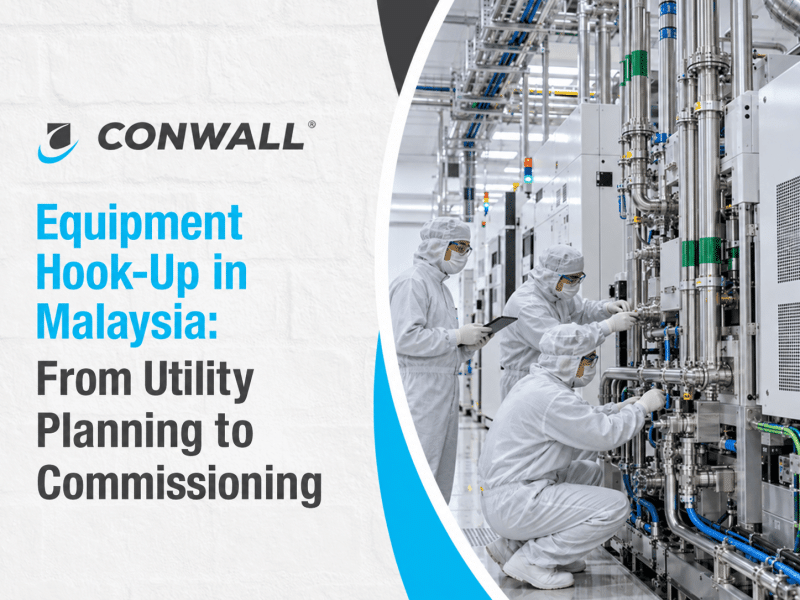
A production machine can arrive on schedule and still be unable to run. Its power supply may be ready, but the cooling connection could be in the wrong position, the exhaust system unfinished or the required utility tests outstanding. Equipment hook-up brings these interfaces together before machine start-up.
For businesses planning industrial construction in Malaysia, this work should be considered during facility design. Waiting until equipment arrives leaves less time to resolve differences between the machine supplier’s requirements and the factory’s available infrastructure.
What Is Equipment Hook-Up?
Equipment hook-up refers to the process of installing, positioning, and connecting industrial, electronic, or manufacturing machinery to power, control systems, and plant utilities.
In industrial facilities, it connects production equipment to the services needed for operation. Depending on the machine, these can include electricity, clean dry air, process cooling water, vacuum, purified water, gases, chemicals, exhaust and drainage. Control signals and safety interfaces may also form part of the agreed scope.
The exact connections depend on the equipment and manufacturing process. A general production machine may need only a few services, while a semiconductor tool can require several utilities with closely controlled operating conditions.
How Does Hook-Up Differ From Base-Build MEP?
Base-build mechanical, electrical and plumbing (MEP) systems provide the facility’s shared infrastructure. Equipment hook-up connects individual machines to that infrastructure at defined points of connection, or POCs. The contract should identify which team provides each connection, isolation device and final termination.
For example, a factory may already have a process cooling network. The hook-up package still needs to establish whether the machine can receive the required flow and temperature at its connection point, and whether the return arrangement is suitable.
Electrical “hook-up wire” is a related but separate term for wiring used inside equipment or panels. Choosing that wire does not cover the wider work of integrating a machine with factory utilities.
Which Utilities Does Equipment Hook-Up Include?
Start with the original equipment manufacturer’s (OEM’s) installation documents. Create a utility matrix that records what each machine needs, what the facility can provide and who will resolve any mismatch. The following table is a planning aid; not every machine requires every service.
| Utility or interface | Information to confirm before installation |
| Electrical power | Voltage, phase, frequency, connected load, protection, isolation and earthing requirements |
| Clean dry air (CDA) | Required pressure, flow and air quality, including moisture, oil and particle limits where specified |
| Process cooling water (PCW) | Supply temperature, flow, pressure, water quality and return conditions |
| Vacuum | Required vacuum level, capacity and compatibility with the process |
| Deionised or ultrapure water (DIW/UPW) | Required water quality, demand, compatible materials and connection arrangement |
| Bulk or specialty gases | Gas type, purity, pressure, flow, compatible materials and specified safety interfaces |
| Chemical delivery | Chemical compatibility, delivery conditions, containment and isolation requirements |
| Exhaust and abatement | Exhaust type, flow, pressure conditions and any treatment required before discharge |
| Process drainage | Waste characteristics, segregation, material compatibility and treatment route |
| Controls and communications | Signal interfaces, alarms, interlocks and responsibility for software integration |
DIW and UPW should not be treated as interchangeable quality specifications. Likewise, general exhaust may be unsuitable for a hazardous process stream. Record the actual requirement rather than relying on a utility label alone.
Conwall’s production machine hook-up and MEP services sit alongside related systems including CDA, vacuum, process cooling, RODI, specialty gas, chemical delivery and exhaust. Reviewing these interfaces together helps define the full project scope.
Six Stages of an Equipment Hook-Up Project
1. Confirm Equipment Requirements and Utility Capacity
Collect the current OEM utility schedule, installation drawings, equipment dimensions, operating weight and maintenance requirements. Confirm the document revision and identify any differences between the purchased machine configuration and the information used during facility design.
Compare those requirements with available utility capacity. Check conditions at the proposed POC, allowing for the other equipment expected to operate at the same time. A spare connection does not automatically mean sufficient usable capacity is available.
Record unresolved items in a shared register with an owner and a required decision date. This gives the project team a clear basis for design and procurement.
2. Coordinate the Layout, Connection Routes and Scope
Agree on the machine’s position, service access, utility routes, support arrangements and connection boundaries. Use coordinated drawings or a 3D model where the installation is complex. Include access for operators, maintenance personnel and future equipment replacement.
Coordinate pipework, cable containment and exhaust with the building structure and cleanroom systems before installation. Conwall’s article on MEP coordination challenges in fast-track fab builds explains why disconnected drawings and late utility decisions can disrupt equipment installation.
At this stage, agree on the bill of materials, installation sequence, inspection requirements and acceptance criteria. Changes to machine specifications should return through the same review process.
3. Prepare for Machine Move-In and Positioning
The move-in plan should address delivery access, equipment weight, floor loading, lifting arrangements and protection of surrounding installations. In operating facilities, coordinate the work with production activities and any approved shutdown windows.
The installation team then positions and levels the machine according to the approved plan and OEM requirements. Anchoring and vibration-control measures depend on the equipment and structural design; they should not be assumed to be identical for every installation.
4. Install the Utility and Control Connections
Specialist teams install the approved piping, tubing, cables, supports and associated components. Materials, connection methods and cleanliness controls must suit the service. Orbital welding may be specified for particular high-purity stainless-steel systems, but it is not a universal requirement for every utility connection.
Maintain identification and inspection records as the work progresses. Confirm that valves, isolation points, instruments and service areas remain accessible after all trades have completed their work.
Control integration also needs an agreed boundary. Connecting a signal cable, programming an interface and qualifying the machine’s production software may belong to different parties.
5. Test and Commission the Installed Systems
Testing should follow approved procedures and the agreed system requirements. Depending on the service, the package may include pressure or leak tests, electrical verification, flow and temperature checks, cleaning or purity verification, instrument checks and tests of relevant alarms or interlocks.
Define the acceptance criteria before testing begins. Record results against the correct system or equipment identifier, including instrument details and the people responsible for witnessing and accepting the work.
Authorised personnel should control isolation, energisation and the introduction of process services. The project team should resolve conditions that prevent safe start-up before releasing the equipment for its next stage.
6. Complete Handover and Support OEM Start-Up
Handover gives the owner a usable record of what was installed, tested and accepted. A practical package can include:
- Approved as-built drawings and the final utility matrix.
- Relevant material, fabrication and inspection records.
- Test reports and instrument calibration records where required.
- Valve, equipment and isolation-point identification.
- Operating and maintenance information for the installed systems.
- An agreed punch list identifying any outstanding work and restrictions.
- Recorded acceptance and responsibility for the next stage.
Utility commissioning does not automatically mean the production machine is qualified. OEM start-up, equipment calibration, software configuration and process qualification may require separate activities. Agree on who owns these tasks and what evidence is needed before production release.
Who Is Responsible for Equipment Hook-Up?
Responsibilities vary with the contract. Establish a written responsibility matrix rather than assuming that everything falls under either the MEP contractor or the machine supplier. The following is a starting point for discussion, not a fixed division of duties.
| Party | Responsibilities to agree |
| Factory owner or facility team | Operating requirements, available utilities, site access, production constraints and acceptance authority |
| OEM or equipment supplier | Machine specifications, installation requirements, interface information and its start-up or qualification scope |
| Designer or EPC team | Design coordination, capacity assessment, utility routes, connection boundaries and change control |
| Hook-up installation team | Agreed connections, installation quality, inspection records and correction of installation defects |
| Commissioning team | Test planning, witnessing, records and confirmation that agreed acceptance conditions are met |
Conwall’s comparison of MEP contractor and general contractor responsibilities provides more context on how these roles interact during an industrial build.
What Changes in Semiconductor and Cleanroom Projects?
Cleanroom equipment hook-up must protect the environment as well as complete the connections. Move-in activities, materials, tools and installation methods need to follow the project’s contamination-control requirements. Work affecting partitions, ceilings or service penetrations also needs coordination with the cleanroom team.
Utility purity, equipment heat loads, exhaust demand and maintenance access can affect the wider facility design. Conwall’s guide to MEP scope in cleanroom construction discusses the relationship between environmental systems and process equipment.
Plan any required environmental checks after installation or modification. Their extent depends on the facility’s specification and the work performed. A cleanroom classification test and a machine utility acceptance test answer different questions; passing one does not establish that the other has passed.
For projects involving new or modified controlled environments, coordinate equipment installation with the cleanroom design and construction scope from the outset.
What Affects Equipment Hook-Up Costs and Timelines?
Machine count alone is a poor basis for estimating hook-up work. Two machines can require very different services, materials, installation conditions and testing packages. A useful quotation needs current equipment information and a clear connection boundary.
The main factors to review are:
- Utility demand: whether existing systems can support the equipment or need upgrades.
- Connection complexity: the number, type, routing and quality requirements of the services.
- Site conditions: access, congestion, work at height and installation within occupied areas.
- Production restrictions: shutdown windows, permits and coordination with live operations.
- 采购: availability of specified valves, instruments, materials and specialist components.
- Acceptance scope: inspection, testing, documentation and OEM attendance requirements.
- Design changes: revised layouts or utility specifications after procurement or installation starts.
There is no dependable universal price or completion period for all hook-up projects. Ask the contractor to state assumptions, exclusions, required information and the milestones that must be met before work can progress.
Equipment Hook-Up FAQs
Is Equipment Hook-Up the Same as Commissioning?
No. Hook-up establishes the physical connections and associated interfaces. Commissioning checks whether the installed systems perform as specified. They are closely connected activities, but physical completion alone does not demonstrate that a system has passed its required tests.
Can Equipment Hook-Up Be Carried Out in an Existing Factory?
Yes, subject to the site’s capacity, access and operational constraints. The work needs coordination with existing production, isolation arrangements and any required shutdowns. Changes to shared utilities must also consider the equipment already connected to them.
What Should I Prepare Before Requesting a Quotation?
Prepare the equipment list, OEM utility requirements, proposed layout, available utility information, installation location and target milestones. Include cleanroom requirements, operating restrictions and the expected testing and documentation package. Identify missing information so the quotation can state its assumptions clearly.
Does Every Machine Need Gas, DI Water and Vacuum Connections?
No. Required utilities depend on the machine and process. Use the OEM’s requirements and the approved design to determine the scope. Adding unnecessary services increases work without making the machine more suitable for production.

Plan Your Equipment Hook-Up with Conwall
Conwall Construction Industries provides industrial construction services from its base in Penang, with EPC capabilities that include MEP systems and production machine hook-up. This allows equipment requirements to be considered alongside the infrastructure that supports them.
Share your equipment list, utility schedule, layout and target installation dates with the team. Contact Conwall to discuss your equipment hook-up requirements and identify the design, installation and commissioning interfaces your project needs to address.
 Chinese
 English