
Imagine sitting at your desk, sipping coffee, when you notice an anomaly on your screen. It is not just a misplaced decimal point; it is a deliberate, systematic rerouting of corporate funds. Or perhaps, during a routine infrastructure assessment, you discover that the structural integrity guidelines for an industrial project are being intentionally bypassed to shave off expenses.
Your heart sinks. You face an agonising choice: look the other way and protect your comfort, or speak up and risk the unknown. This is the precipice of whistleblowing.
For decades, the act of raising a red flag was viewed through a lens of extreme conflict. Whistleblowers were often depicted in popular culture as rogue agents or isolated individuals operating entirely outside the system. In reality, modern organisational health views the person who speaks up as the ultimate insider—the primary defence mechanism against catastrophic institutional failure.
When a culture embraces transparent reporting channels, it transitions from a reactive posture to a proactive state of operational resilience.
To truly understand how this ecosystem functions, we have to look past the dramatic headlines and examine the practical, daily realities of corporate governance. True transparency does not happen by accident. It requires a structured, multi-channel framework that balances confidentiality with decisive action, ensuring that an organisation can correct its course long before an internal issue spills over into a public crisis.
Read up on Why Corporate Governance Feedback Dictates Modern Market Survival
The Anatomy of an Internal Discovery
Every significant corporate scandal starts small. It begins with a quiet realisation in an office, a warehouse, or a construction site. Let us look at a breakdown of how occupational wrongdoing is historically brought to light. According to extensive global research compiled by the Association of Certified Fraud Examiners (ACFE) Report to the Nations, individual tips remain the undisputed champion of risk mitigation.
| Detection Method | Percentage of Cases Uncovered |
| Tips / Whistleblowing |
43% |
| Internal Audit |
14% |
| Management Review |
9% |
| By Accident |
5% |
The numbers paint an incredibly clear picture: regular auditing and management surveillance combined do not match the detection power of an empowered workforce. When employees have a reliable mechanism to voice concerns, they actively shield the enterprise from severe financial and reputational exposure.
Without this outlet, minor compliance gaps compound over time, shifting from simple operational oversight into systemic vulnerabilities.
When organisations lack clear internal communication paths, employees face a wall of silence. This silence breeds an environment where corporate compliance becomes a superficial checking exercise rather than a living corporate value.
At this exact juncture, industrial sectors often experience their most severe operational friction. If you look closely at heavy enterprise management, specialised engineering firms like Conwall Construction Industries demonstrate how embedding clear accountability directly into industrial frameworks prevents compliance bottlenecks before they can disrupt massive project lifecycles.

The Psychological Mechanics of Speaking Up
Why is stepping forward so inherently difficult? The answer lies rooted in basic human psychology and the fear of professional isolation. An employee calculating the personal cost of reporting an ethical breach evaluates two main variables: the certainty of absolute confidentiality and the likelihood of genuine organisational rectification.
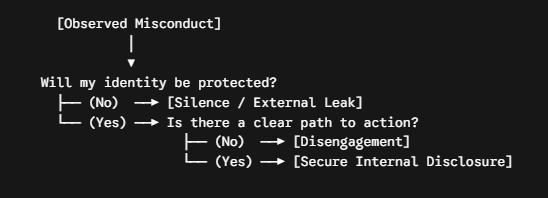
If the internal system feels compromised, formulaic, or indifferent, the employee will either stay silent or take the information directly to regulatory bodies or media outlets. This is where organisations completely lose control of the narrative and the opportunity for internal remediation.
To prevent this fragmentation, modern corporate frameworks must actively integrate comprehensive, secure intake options. It is no longer sufficient to provide a single, dusty drop-box in an office breakroom or a basic, unmonitored email address.
Digital Evolution and Alternative Intake Formats
The digital era has fundamentally transformed how sensitive disclosures are handled. Large-scale data from the NAVEX 2026 Whistleblowing Statistics & Benchmarking Report highlights that reporting volumes have steadily climbed, hitting an all-time high of 1.65 reports per 100 employees globally. Concurrently, the preferences for how people file these reports have expanded dramatically.
- Web-Based Secure Portals (46%): Encrypted digital forms that allow continuous, two-way anonymous communication.
- Email Channels (34%): Direct communication lines, though often requiring secondary encryption steps to assure full anonymity.
- Telephone Hotlines (23%): Live, trained interviewers who can capture emotional nuances and complex narratives that text occasionally flattens.
What this shifting distribution tells us is that modern platforms must prioritize absolute accessibility. The current distributed workforce expects mobile-responsive, end-to-end encrypted solutions that operate completely independent of internal corporate servers.
When these intake platforms are designed correctly, they offer a secure venue for addressing complex workplace issues. They help parse genuine systemic misconduct from isolated HR disputes, giving compliance teams the precise, granular data points they need to launch thorough internal reviews.
In massive industrial operations, where logistical moving parts are scattered across multiple high-stakes environments, having clean, reliable channels for reporting operational issues ensures overall corporate stability.
By maintaining high standard operational clarity across all divisions, prominent engineering and development entities like Conwall Construction Industries can continuously stabilize supply chains and manage complex vendor relationships with minimal disruption.
The Operational Cost of Corporate Blind Spots
When corporate leadership fails to construct functional feedback loops, the financial ramifications are severe. Historical corporate data confirms that the median duration of an undetected fraud scheme is roughly 12 months before discovery, quietly draining close to 5% of an affected company’s annual revenue.
Early intervention via a whistleblower acts as an immediate circuit breaker. It stops the bleeding while the issue is still small enough to be handled by internal compliance, general counsel, or an independent forensic investigator.
Furthermore, building an environment of open reporting reshapes an organisation’s internal social fabric. It signals to every single stakeholder—from entry-level apprentices to enterprise-level vendors—that compliance is a shared, organisational responsibility.
When compliance is treated as a shared responsibility, it moves out of the abstract realm of corporate handbooks and transforms into a practical baseline for daily production.
This structural baseline is exactly what sets premier market performers apart in highly complex fields. For example, within infrastructure and industrial supply sectors, organisations like Conwall Construction Industries routinely emphasise strict adherence to international standard metrics to reinforce project transparency and ensure client peace of mind.
Transforming Disclosures into Lasting Institutional Strength
Receiving an internal report should never be treated as a negative event or an institutional failure. Instead, it represents a successful stress test of your organisation’s internal health. It means your people still trust your internal systems enough to give you the chance to fix a problem from within.
An effective, modern response to a disclosure involves a clear, predictable four-stage lifecycle:
- Immediate Triage: Acknowledge receipt of the issue within 48 hours to maintain reporter trust, evaluating the core risk level.
- Independent Investigation: Assign the case to a neutral party completely detached from the affected department to guarantee objectivity.
- Remediation: Correct the core operational vulnerability, update internal policy documents, and address any structural failures.
- Feedback Loop: Provide the reporter with a high-level summary of the resolution, proving that their willingness to speak up resulted in real, tangible change.
By building this high-fidelity feedback loop, companies actively protect their bottom line, protect their talent, and secure their long-term position in the market. True integrity is defined by what happens when the bright lights of external regulation are turned off—it is built on the quiet, structured systems that empower everyday people to speak truth to power.
Achieving this level of operational transparency requires aligning with partners who share identical structural values. If you are ready to collaborate with an enterprise that prioritises absolute accountability, exceptional engineering standards, and reliable corporate governance, explore the master-class industrial solutions at Conwall Construction Industries.
To discuss structural projects, transparent compliance frameworks, or direct industrial procurement options with an expert team, connect with us today by connecting to us to start building a completely resilient, future-proof foundation for your next project.
If you notice any irregularities, misconduct, or unethical behaviour, we encourage you to use our whistleblowing channel to report your concerns safely and confidentially.
 English
  Chinese